
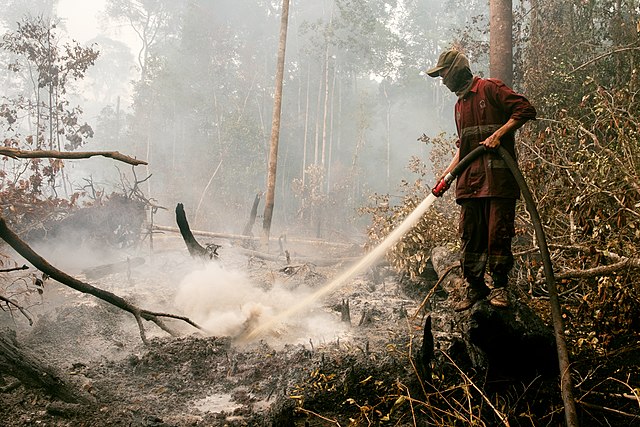
Peatland fire in Kalimantan, Indonesia in 2019
Image credits: DenY Krisbiyantoro, CC BY-SA 4.0, via Wikimedia Commons
Recently, there is talk about a “super El Nino” might be on the horizon. (See e.g. today’s article in The Straits Times.) As usual, some are tempted to speculate about the connection between climate change and the “super”lative description of the El Nino. Well, first of all, a “super” El Nino is not an official categorisation; it merely means an El Nino event that warms the central equatorial Pacific Ocean by more than 2 degrees Celsius above the long-term average sea surface temperature there. So it is not any special except for the higher magnitude. But high-magnitude events do occur from time to time in nature. The crucial point is that “high intensity” is no reason to suspect “abnormality” or “climate change”.
So what should get us worried about climate change as far El Nino and La Nina are concerned? I suggest the focus should be on their cumulative frequency measured against a rising long-term average ocean temperature over, let’s say, 40 years. Why look at statistics over such long time as nearly half a century? This is because the mean recurrence period of an El Nino event is between 2 to 7 years, which yields an expectation of 9 events, plus or minus 3 events or so, over 40 years (assuming Poisson statistics for argument’s sake). For the observed frequency to rise beyond 3 standard deviations and be labelled as a significant change against the backdrop of natural randomness, it must double to 18. When sampled over fewer years, the ratio of standard deviation to expected frequency rises, resulting in requiring the observed frequency to more than double to be considered significant: e.g. nearly triple for a 20-year sampling period.
Disregarding the mathematical details of the above argument (for they are meant to illustrate more than prove), this comment immediately makes any single El Nino event, even a “super” one, less exciting as an indicator of climate change. Moreover, any statistically robust observation study of El Nino frequency in a changing climate will likely have to stretch over a long period (relative to human lifespan) from the mid-1980s, the time when comprehensive instrumental records of equatorial Pacific Ocean sea surface temperature began. By the end of such a study period, other weather phenomena affected by climate change and of shorter time-scale than El Nino and La Nina will have already made their mark on human society.